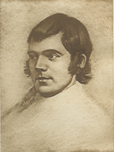
To A Mouse
by Robert Burns
[On Turning Her Up In Her Nest With The Plough, November, 1785]
Wee, sleekit, cow'rin', tim'rous beastie,
O, what a panic's in thy breastie!
Thou need na start awa sae hasty,
Wi' bickering brattle!
I wad be laith to rin an' chase thee,
Wi' murd'ring pattle!
I'm truly sorry man's dominion,
Has broken nature's social union,
An' justifies that ill opinion,
Which mak's thee startle
At me, thy poor, earth-born companion,
An' fellow-mortal!
I doubt na, whyles, but thou may thieve;
What then? poor beastie, thou maun live!
A daimen-icker in a thrave
's a sma' request:
I'll get a blessin' wi' the lave
And never miss't!
Thy wee bit housie, too, in ruin!
It's silly wa's the win's are strewin'!
An' naething, now, to big a new ane,
O' foggage green!
An' bleak December's winds ensuin',
Baith snell and keen!
Thou saw the fields laid bare an' waste,
An' weary winter comin fast,
An' cozie here, beneath the blast,
Thou thought to dwell,
'Till, crash! the cruel coulter past
Out thro' thy cell.
That wee bit heap o' leaves an' stibble,
Has cost thee mony a weary nibble!
Now thou's turn'd out, for a' thy trouble,
But house or hald,
To thole the winter's sleety dribble,
An' cranreuch cauld!
But, Mousie, thou art no thy lane,
In proving foresight may be vain;
The best-laid schemes o' mice an 'men
Gang aft a-gley,
An' lea'e us nought but grief and pain,
For promis'd joy.
Still thou art blest, compar'd wi' me!
The present only toucheth thee:
But, och! I backward cast my e'e,
On prospects drear!
An' forward, tho' I canna see,
I guess an' fear.
Notes to the poem:
Gilbert Burns says, "The verses to 'Mouse' and 'Mountain Daisy' were composed on the occasions mentioned, and while the author was holding the plough. I could point out the particular spot where each was composed. Holding the plough was a favorite situation with Robert for poetic composition, and some of his best verses were produced while he was at that excercise."
"John Blane," says Mr. Chambers, "who was farm servant at Mossgiel at the time of its composition, still (1838) lives at Kilmarnock. He stated to me that he recollected the incident perfectly. Burns was holding the plough, with Blane for his driver, when the little creature was observed running across the field. Blane, having the pettle, or plough-cleaning utensil, in his hand at the moment, was thoughtlessly running after it to kill it, when Burns checked him, but not angrily, asking what ill the poor mouse had ever done him. The poet then seemed to his driver to grow very thoughtful, and, during the remainder of the afternoon, he spoke not. In the night time, he awoke Blane, who slept with him, and, reading the poem, which had in the meantime been composed, asked what he thought of the mouse now."
Source:
The Poetical Works Of Robert BurnsCopyright 1910
Ward, Lock, and Co., Ltd