The Rime Of The Ancient Mariner
Part VII. (This Hermit good lives in that wood...)
by Samuel Taylor Coleridge
| This Hermit good lives in that wood Which slopes down to the sea. How loudly his sweet voice he rears! He loves to talk with marineres That come from a far countree. | The Hermit of the Wood | |
| He kneels at morn, and noon, and eve -- He hath a cushion plump: It is the moss that wholly hides The rotted old oak-stump. | ||
 | ||
The skiff-boat neared: I heard them talk,Why, this is strange, I trow! | ||
Strange, by my faith!the Hermit said -- "And they answered not our cheer! The planks looked warped! and see those sails, How thin they are and sere! I never saw aught like to them, Unless perchance it were | Approacheth the ship with wonder. | |
| Brown skeletons of leaves that lag My forest-brook along; When the ivy-tod is heavy with snow, And the owlet whoops to the wolf below, That eats the she-wolf's young." | ||
Dear Lord! it hath a fiendish look ---- Push on, push on! Said the Hermit cheerily. | ||
| The boat came closer to the ship, But I nor spake nor stirred; The boat came close beneath the ship, And straight a sound was heard. | ||
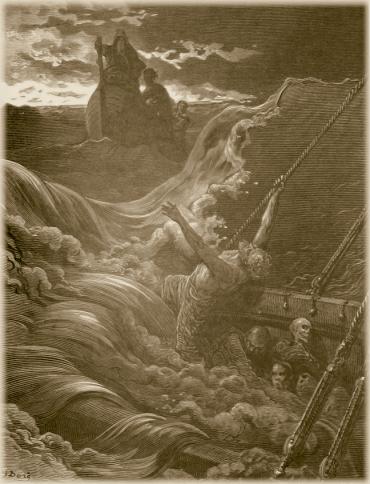
| Under the water it rumbled on, Still louder and more dread: It reached the ship, it split the bay; The ship went down like lead. | The ship suddenly sinketh. | |
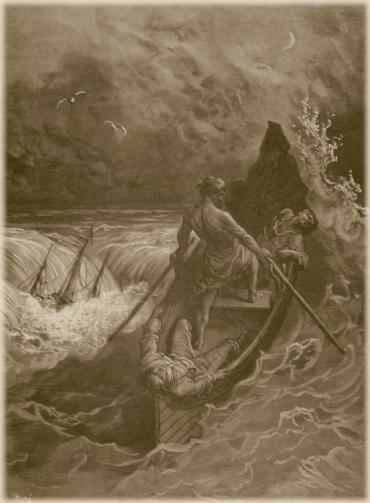 | ||
| Stunned by that loud and dreadful sound, Which sky and ocean smote, Like one that hath been seven days drowned My body lay afloat; But swift as dreams, myself I found Within the Pilot's boat. | The ancient Mariner is saved in the Pilot's boat. | |
| Upon the whirl, where sank the ship, The boat spun round and round; And all was still, save that the hill Was telling of the sound. | ||
| I moved my lips -- the Pilot shrieked And fell down in a fit; The holy Hermit raised his eyes, And prayed where he did sit. | ||
| I took the oars: the Pilot's boy, Who now doth crazy go, Laughed loud and long, and all the while His eyes went to and fro. Ha! ha!quoth he, full plain I see, | ||
| And now, all in my own countree, I stood on the firm land! The Hermit stepped forth from the boat, And scarcely he could stand. | ||
O shrieve me, shrieve me, holy man! The Hermit crossed his brow. Say quick,quoth he, I bid thee say -- | The ancient Mariner earnestly entreateth the Hermit to shrieve him; and the penance of life falls on him. | |
| Forthwith this frame of mine was wrenched With a woful agony, Which forced me to begin my tale; And then it left me free. | ||
| Since then, at an uncertain hour, That agony returns: And till my ghastly tale is told, This heart within me burns. | And ever and anon throughout his future life an agony constraineth him to travel from land to land. | |
| I pass, like night, from land to land; I have strange power of speech; That moment that his face I see, I know the man that must hear me: To him my tale I teach. | ||
| What loud uproar bursts from that door! The wedding-guests are there: But in the garden-bower the bride And bride-maids singing are: And hark the little vesper bell Which biddeth me to prayer! | ||
| O Wedding-Guest! this soul hath been Alone on a wide wide sea: So lonely 'twas, that God himself Scarce seemed there to be. | ||
| O sweeter than the marriage-feast, 'Tis sweeter far to me, To walk together to the kirk With a goodly company! -- | ||
| To walk together to the kirk, And all together pray, While each to his great Father bends, Old men, and babes, and loving friends And youths and maidens gay! | ||
| Farewell, farewell! but this I tell To thee, thou Wedding-Guest! He prayeth well, who loveth well Both man and bird and beast. | And to teach, by his own example, love and reverence to all things that God made and loveth. | |
| He prayeth best, who loveth best All things both great and small; For the dear God who loveth us, He made and loveth all. | ||
| The Mariner, whose eye is bright, Whose beard with age is hoar, Is gone: and now the Wedding-Guest Turned from the bridegroom's door. | ||
| He went like one that hath been stunned, And is of sense forlorn: A sadder and a wiser man, He rose the morrow morn. | ||
1797-1798
Source:
The Golden Book Of ColeridgeCopyright 1914
London: J.M. Dent & Sons, Ltd.
New York: E. P. Dutton & Co.